
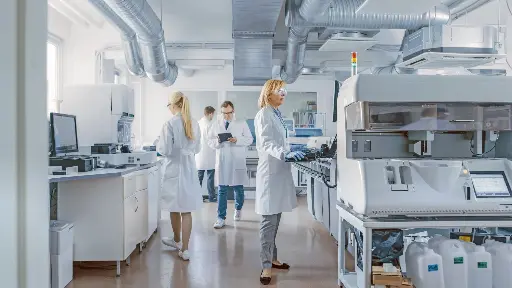
Samples contaminated with bacteria, fungi or mycoplasma don’t have the courtesy to spoil the experiment. No, they produce good results. That’s the problem. When sterilization quietly fails, a lab doesn’t get a bad run; it gets a publication that nobody can replicate.
The difference between clean and sterile
Most lab environments are clean. Few are sterile. The distinction matters because treating clean and sterile as if they’re the same thing leads to problems.
Sterile means the absence of viable life. That’s life in any form – which in lab terms means even the hardiest bacterial spores, plus fungi and yeasts. Sterility is not a permanent state, but the process of sterilizing achieves it. Probably the most common method of sterilization in the lab is the autoclave, which sterilizes by the super-heated pressurized steam it uses. The conditions in an autoclave cycle are about 121 °C for a minimum of 15 minutes. This amount of heat and pressure is sufficient to kill all pathogens, including those unaffected by most cleaning agents.
Biofilm is a good example. Left undisturbed on glassware or transfer devices, bacteria can construct layered colonies that are resistant to standard disinfectants and nearly invisible during routine inspection. A researcher working with peptides or proteins in a study environment that harbours biofilm isn’t working in a sterile lab. They’re working in one that looks sterile.
Reconstitution is where researchers cut corners
The most frequent point of failure isn’t equipment sterilisation – it’s the liquids used to reconstitute powdered compounds. Despite widespread application, plain deionised water isn’t suitable for many sensitive research applications. It lacks antimicrobial properties, and its mineral content can catalyse the hydrolysis of peptides, effectively destroying the compound before you’ve had the chance to study it.
The distinction between sterile and bacteriostatic becomes critical here. A single-use sterile solution is appropriate for a single puncture and immediate use. Multi-dose vials require something different – a diluent that actively suppresses bacterial replication across repeated access points.
Bacteriostatic water contains 0.9% benzyl alcohol, which inhibits bacterial growth over a 28-day period after initial puncture. For researchers working with multi-dose vials, this isn’t a convenience feature. It’s a requirement for maintaining the integrity of the solution across the full duration of use. Using a non-bacteriostatic diluent in these applications introduces a growing contamination risk with every subsequent draw.
Contamination doesn’t announce itself
In some cases, infected cell cultures don’t show visible signs of degradation. In others, subtle culture changes may occur. Cell morphology can remain unchanged, but cells behaviorally alter metabolically. This can lead to subtle changes in gene expression, and ultimately, downstream data that reflects a biological state that was never actually present in the intended sample. The result is a published conclusion based on contaminated material.
Transfer of microbes from one sample to another carries the same risk in comparative research. A study designed to isolate a single variable becomes invalid the moment that variable is co-introduced to the control group. No amount of statistical analysis fixes data that was corrupted before collection.
SOPs exist because human behaviour is inconsistent
Validation protocols document that a sterilisation method works. Standard Operating Procedures document that the people using it are applying it consistently. Both matter, but SOPs address the leading cause of contamination: human error.
Researchers change. Lab staff turn over. A procedure that one person follows correctly isn’t guaranteed to be followed correctly by someone who joined six months later. Without written, enforceable SOPs, sterilisation becomes dependent on individual habit rather than institutional standard.
Peer-reviewed publication increasingly scrutinises methodology, and replication failures have pushed journals to demand more rigorous documentation of sterile handling procedures. Labs that want their work to hold up under external review don’t have the option of treating sterilisation as informal. It has to be a defined process with accountability attached to it.
What equipment sterilisation actually protects
Proper sterilization is important for the safety of subjects in in vivo research and the integrity of data in in vitro experiments. High-value reagents such as antibodies, synthesized peptides, and culture media are costly and often irreplaceable during the timeframe of a study. Metabolites generated by contaminating bacteria degrade these compounds, even if the actual contamination is not the subject of the experiment.
A reagent that has been compromised doesn’t always produce a failure. Often, it causes just enough change for the result to be not quite what was expected, and that can be difficult to detect. Autoclaves, biosafety cabinets, and sterile transfer equipment all represent costs hitting the laboratory budget right now; the cost of repeating an experiment, throwing out contaminated reagents, or – heaven forfend – retracting a publication will be even higher.
Sterilization is not a basic hygiene factor of good lab practice. It’s the necessary precondition for the validity of the entire scientific method. Data obtained without it is not just useless, it is actually misleading, and the whole field pays for that in time, resources, and reputation.


Leave a Reply